
How Does AI Work? A Plain-English Explanation
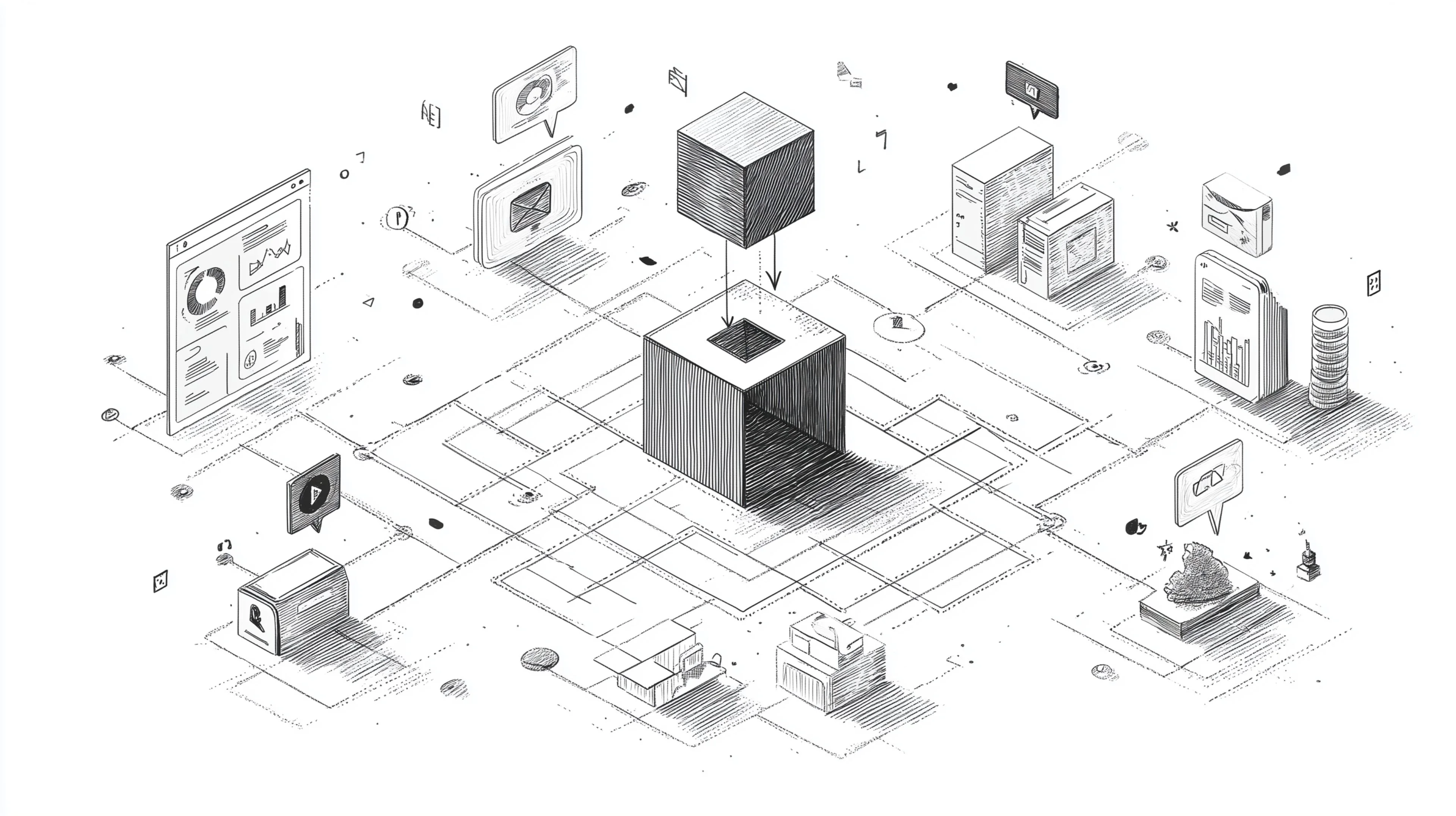
Artificial intelligence is everywhere — in your email inbox, your navigation app, your customer service chatbot, and increasingly, your workplace. But when someone asks "how does AI actually work?", most explanations either oversimplify to the point of meaninglessness or drown you in technical jargon. This article cuts through both. By the end, you'll have a clear mental model of how AI works — without needing a computer science degree to follow along.
The Basic Idea Behind AI
At its core, AI is about pattern recognition at scale. Humans are naturally good at recognising patterns — we learn from experience, adjust our behaviour, and apply what we've learned to new situations. AI systems do something similar, but at a speed and scale that no human could match.
Think about how you learned to identify a dog. You saw hundreds of dogs — big ones, small ones, fluffy ones, sleek ones — and over time your brain formed a mental model of what "dog" means. AI learns the same way, except instead of years of lived experience, it processes millions of labelled examples in a matter of hours. The result is a system that can look at a photo it has never seen before and correctly identify the dog in it.
This principle — learning patterns from examples and applying them to new situations — underpins virtually every AI system in use today.
Machine Learning — How Computers Learn from Data
Traditional software follows explicit rules written by a programmer. You want the computer to sort a list alphabetically? A programmer writes the sorting logic, step by step. Machine learning takes a fundamentally different approach: instead of writing rules, you feed the system data and let it figure out the rules itself.
Here's a simple example. Suppose you want to build a system that predicts whether a loan applicant will default. In traditional programming, you'd write rules like "if income is below X and debt is above Y, flag as high risk." In machine learning, you show the system thousands of historical loan records — each labelled as "repaid" or "defaulted" — and let it discover the patterns that best predict the outcome.
The system learns by making predictions, comparing them to the correct answers, measuring the gap (called the "error" or "loss"), and adjusting its internal settings to reduce that gap. This adjustment process repeats millions of times until the system becomes reliably accurate. That process is called training.
Neural Networks and Deep Learning
Neural networks are the architecture behind most modern AI. They're loosely inspired by the human brain — not in a literal biological sense, but in the idea of interconnected nodes that pass signals to one another.
Imagine a network arranged in layers. The first layer receives raw input — say, the pixel values of an image. Each subsequent layer detects increasingly abstract features. Early layers might detect edges and colours. Middle layers might recognise shapes and textures. Later layers might identify objects and their relationships. The final layer produces the output: "this is a dog," "this is spam," or "this customer is likely to churn."
"Deep learning" simply refers to neural networks with many layers — sometimes hundreds or thousands deep. The depth is what gives modern AI its extraordinary capability. More layers means the system can learn more complex, nuanced patterns from data.
"AI doesn't think like a human — it identifies statistical patterns in data with extraordinary precision. Understanding that distinction is the first step to using it well."
How Large Language Models Work
Large language models (LLMs) — the technology behind ChatGPT, Claude, and similar tools — are a specific type of neural network trained on vast quantities of text. Understanding how they work demystifies a lot of the hype and the confusion.
During training, an LLM processes enormous amounts of text from books, websites, articles, and code. Rather than memorising this content, it learns the statistical relationships between words and concepts — what typically follows what, which ideas tend to appear together, how sentences are structured across different contexts.
Text is broken into small units called tokens (roughly corresponding to words or word fragments). The model learns to predict the next token given everything that came before it. Repeat this process across hundreds of billions of tokens, and what emerges is a model with a surprisingly rich understanding of language, reasoning, and knowledge.
When you send a message to ChatGPT, the model doesn't "look up" an answer. It generates a response token by token, each one chosen based on what is statistically most likely and most coherent given the context you've provided. The quality of that response depends heavily on how well you've framed your prompt — which is why prompt engineering has become a genuinely valuable skill.
AI in Practice — From Theory to Business Value
Understanding how AI works isn't just an intellectual exercise — it has direct practical implications for how you use it in your business.
- AI learns from data — so the quality and volume of your data directly determines the quality of your AI outputs. Garbage in, garbage out applies here more than anywhere.
- AI predicts, it doesn't know — LLMs can produce confident-sounding responses that are factually wrong. Always verify outputs for high-stakes decisions.
- Context is everything — the more relevant context you give an AI system, the more useful its output. Vague prompts produce vague results.
- The best results come from human-AI collaboration — AI handles pattern recognition and scale; humans bring judgement, ethics, and accountability. Neither replaces the other.
Businesses that understand these fundamentals use AI more effectively, avoid common pitfalls, and are better positioned to identify where AI will genuinely add value versus where it will create noise. That understanding starts with education — and it doesn't require becoming a data scientist. It requires becoming a more informed operator.
Ready to Put AI to Work in Your Business?
Understanding how AI works is just the first step. Zenias delivers hands-on AI training that turns that understanding into practical skills — tailored to your team, your tools, and your industry.
Explore AI Training